
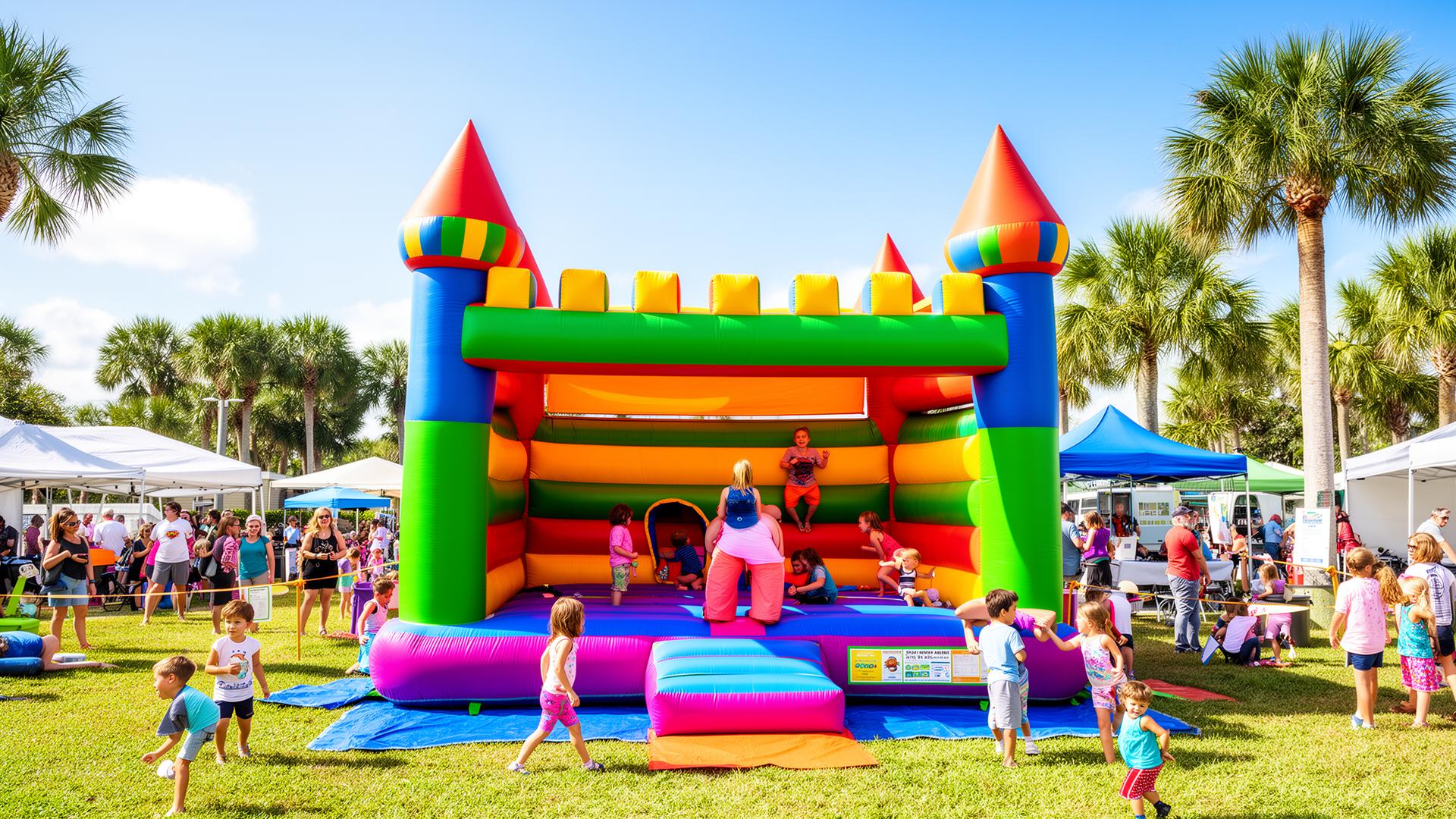
Obstacle Course Insurance
Annual coverage for inflatable obstacle course rental operators — pediatric and adult courses, multi-station structures, venue-ready certificates quickly.
- Veteran-Owned
- 100+ Yrs Experience
- Fast Certificates
- Real Agents
- Florida Experts
- Veteran-OwnedIndependent agency
- 100+ Years CombinedCommercial expertise
- Florida-ResidentDeLand, FL office
- Fast COIsMost certificates issued quickly
Trusted Carrier Partners



Why First Commercial
Why Florida Businesses Choose Us
We focus on the commercial insurance lines that need real expertise — and we treat every client like a long-term partner, not a policy number.
Annual — Not One-Day
Year-round liability that lets you bid more events without per-event quoting.
Venue-Ready Certificates
Anchoring documentation, additional insured, waiver of subrogation — fast.
Specialty Carrier Access
Bounce house and inflatable carriers that other agencies can’t place.
We Answer the Phone
Talk to a real Florida agent who knows the inflatable rental industry.
Who needs obstacle course insurance
If your inventory includes any inflatable structure where participants traverse multiple stations in sequence, you have an obstacle course exposure. Coverage applies to:
- Inflatable rental businesses with one or more obstacle course units
- Mobile party rental operators bundling courses with other inflatables
- School field-day vendors providing pediatric obstacle courses
- Corporate event vendors providing adult-rated team-building courses
- Family entertainment centers with permanent or seasonal obstacle structures
The multi-station risk profile
Obstacle courses are the multi-station outlier in the inflatable family. Multiple participants move through multiple risk vectors simultaneously. The exposures we schedule for:
- Transition-area injuries — most claims happen between stations as a participant misjudges the footing, the seam, or the height change.
- Setup-and-breakdown exposure on long footprints — a 60-foot course can take 45 minutes to inflate and another 30 to break down. Crew injuries during setup and breakdown drive workers compensation, not GL, but are still part of the event-day timeline.
- Anchor count requirements — often 8+ stake points versus 4 on a bounce house. The manufacturer manual is authoritative.
- Wind exposure on elongated structures — a long course catches more wind than a compact bounce house. Kill-wind speed should be honored.
- Concurrent participant counts — three or four participants on a course at the same time, each at a different station, multiplies the claim count when something goes wrong.
What obstacle course insurance covers
- Bodily injury — third-party medical and legal costs.
- Property damage — venue or third-party property damage.
- Products and completed operations — claims after the event ends.
- Inland marine (optional) — coverage for the courses themselves.
- Commercial umbrella (optional) — extra layer for higher-limit corporate or school-district contracts.
Pediatric vs adult course considerations
Pediatric courses (typically rated for ages 3–12) and adult courses (teens through adults) underwrite differently. Adult courses have higher kinetic energy — bigger adults, faster transitions, more force at impact. Many carriers price the two classes separately, and we schedule each course on the policy with its rated age range so the premium reflects actual exposure rather than a blended rate.
If a single course is sold to both pediatric birthday parties and adult corporate field days, schedule it as adult-capable. Restricting the course to pediatrics on the policy and then renting it to an adult event is the kind of disclosure mismatch that can affect a claim.
Setup and breakdown exposure
Long-footprint courses sit in transit longer, take longer to inflate, and have more seams to inspect than a single bounce house. The operational pattern most likely to generate a claim:
- Staging: equipment in transit on a trailer through public roads
- Setup: tools and crew on site, vehicle on venue property
- Inflation: blower running, crew on the course confirming each station holds
- Active event: participants moving through, attendants posted at risk stations
- Breakdown: residual moisture, exhausted crew, often in the dark
Document anchor counts, attendant posts, and incident protocol for each event. The documentation tightens both your premium and your defense if a claim arises.
Common venue requirements
- $1M / $2M COI is standard; corporate field days commonly require $2M / $1M umbrella
- Venue named as additional insured
- Waiver of subrogation
- 30-day cancellation notice
- Primary and non-contributory endorsement (school districts, county parks)
- Posted attendant on multi-station courses for some venues
Ready to quote your obstacle course business?
What affects your premium
- Annual revenue
- Number and footprint of courses
- Pediatric vs adult mix
- Claims history
- State of operation
- Event types served (school, corporate, public, private)
- Trained-attendant policy at each course